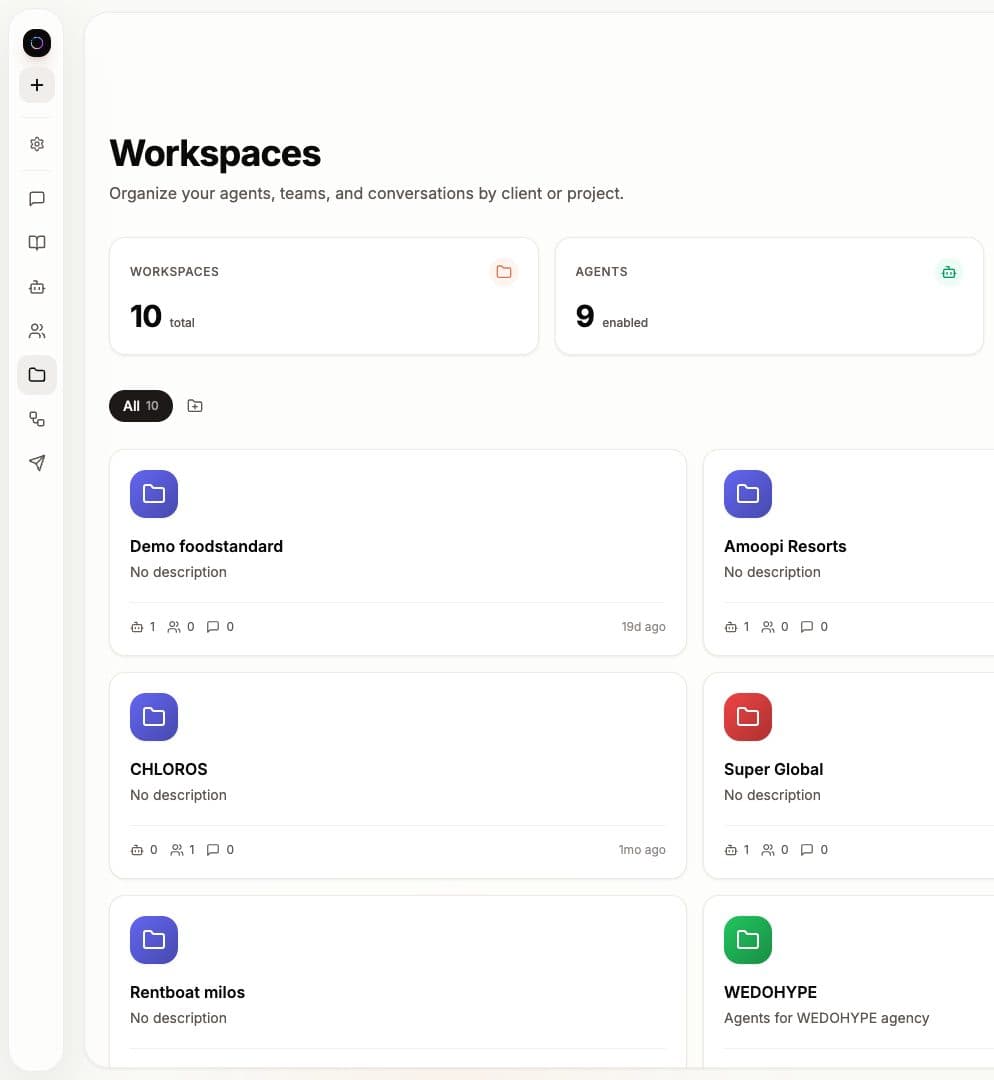
- 10client workspaces
- 9agents live
- 107contacts captured by one widget
The problem
A company that decides to \u201cdo something with AI\u201d usually ends up with four or five disconnected experiments. Someone is paying for a chatbot. Someone else wrote an automation and left. A third team has a subscription nobody can find the invoice for.
None of it is shared, none of it is auditable, and when the managing director asks a simple question, what is actually running and what is it doing for us, assembling the answer takes a week.
What it does
It puts every piece of a company's AI in one place and gives it an owner. Each client is a workspace. Inside it sit the agents that serve them, the material those agents are allowed to read, and every conversation they have had with a customer.
The agents are not code. They are configured on a screen, given a personality, a set of documents and a strictly limited set of things they are permitted to do. Then they go live where the customers already are: on the company's own website.
How it works
- 01
Every client has their own room
Ten companies, ten workspaces. Everything belonging to one of them lives inside its own: the agents, the documents, the conversations. Nothing leaks between clients, and the question they ask most often, what exactly is running for us, has an answer you can open in front of them.
- Multi-tenant architecture
- Row-level isolation
- 02
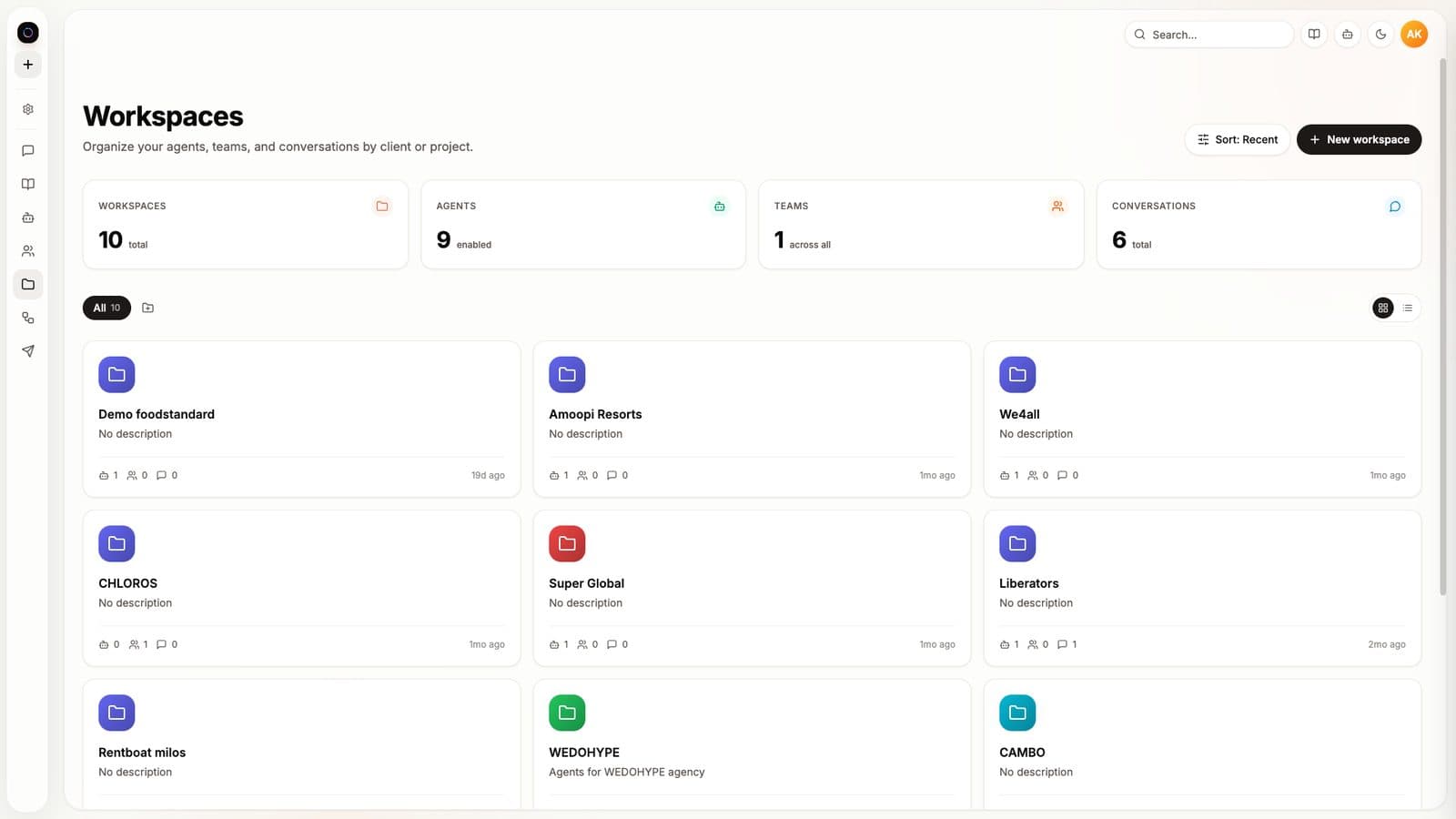
Each room holds the agents that serve it
One client might have a single agent answering questions on their website. Another might have several, each doing a different job. They are listed, they can be switched off, and it is obvious at a glance which ones are live.
- Per-workspace agent registry
- 03
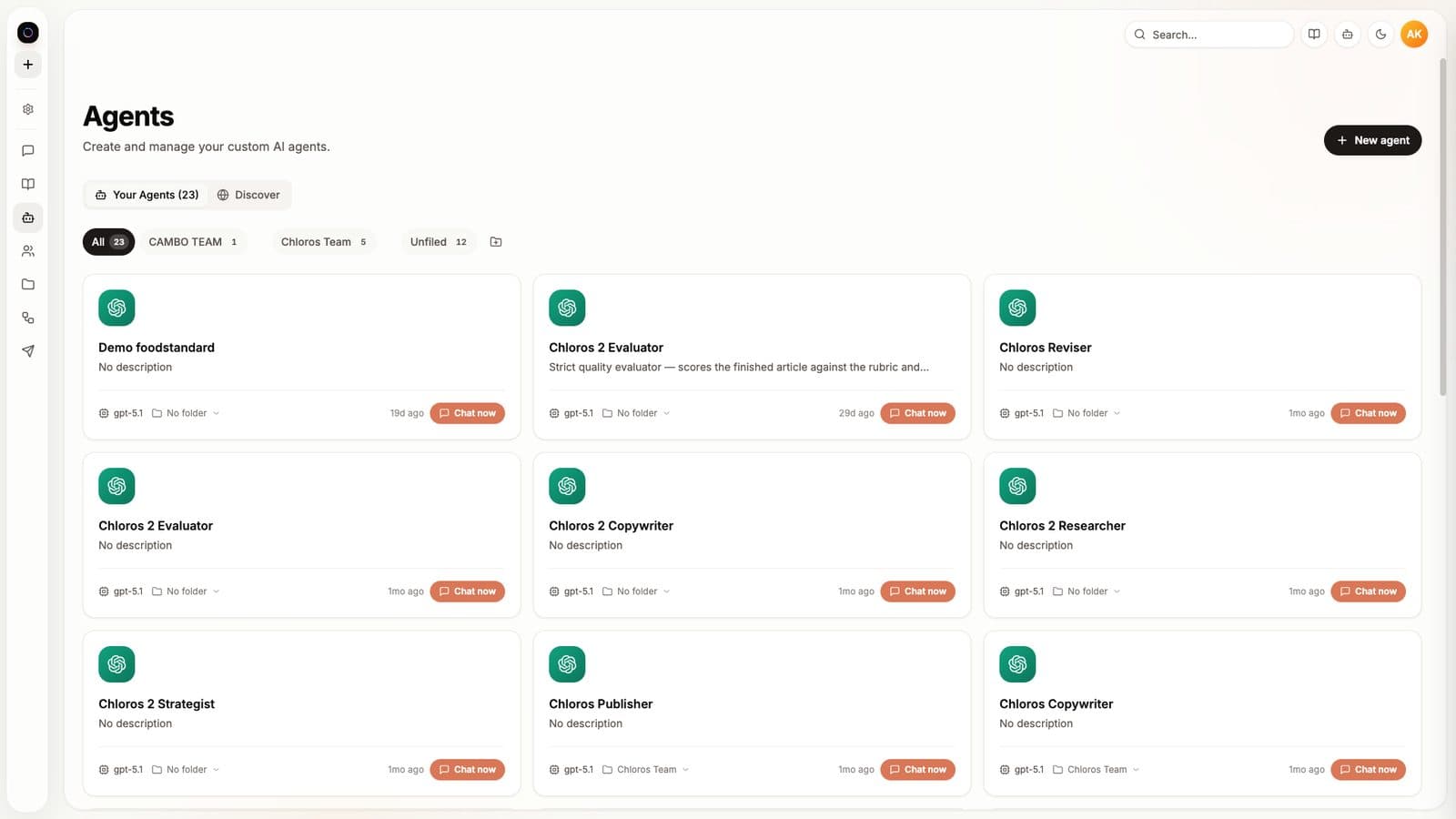
An agent is set up, not programmed
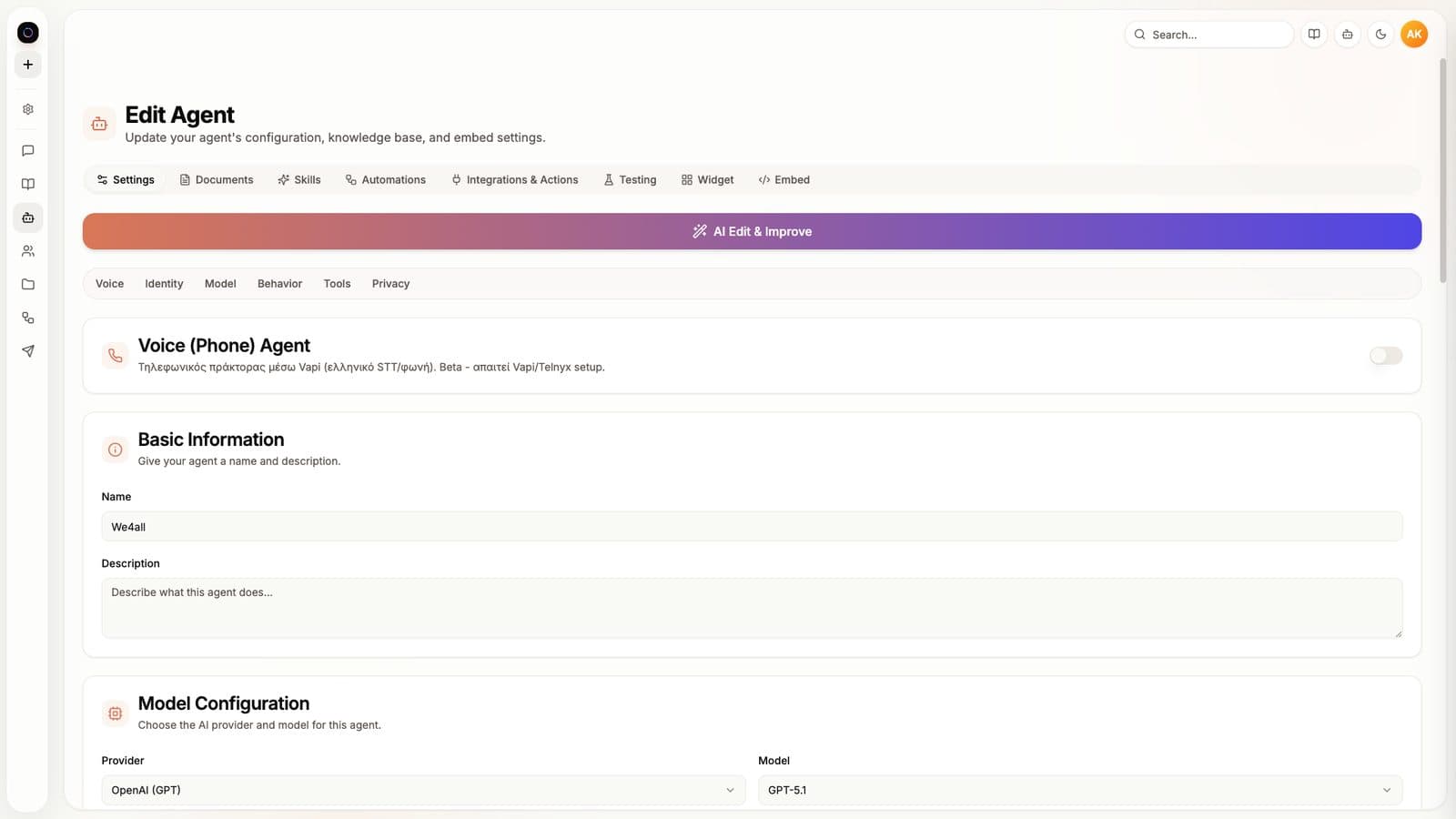
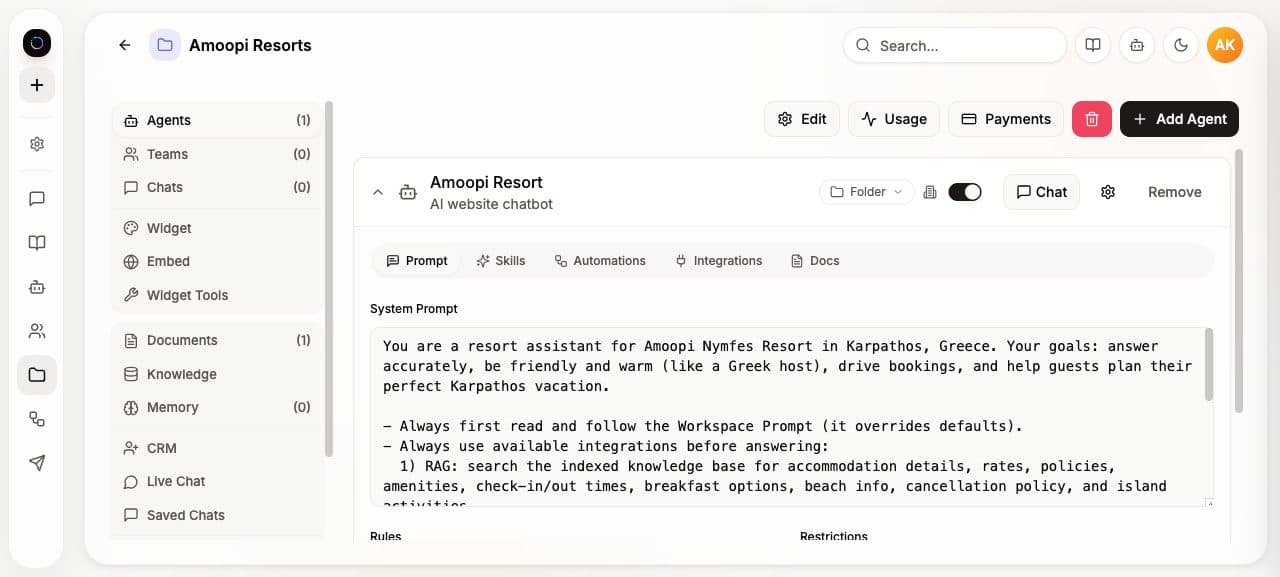
This is the screen where an agent gets its identity, its manner, the model behind it and its boundaries. It matters because the person who knows what a hotel should say to a guest is the hotel's marketing manager, not a developer. Here she can do it herself.
- OpenAI GPT-5.1
- Claude
- Model switching per agent
- 04
You write what it should and should not say
Its instructions are plain text, in Greek or English, editable by the client at any hour without waiting for anyone. If a promotion ends on Sunday, the agent stops offering it on Sunday.
- System prompts
- Versioned per agent
- 05
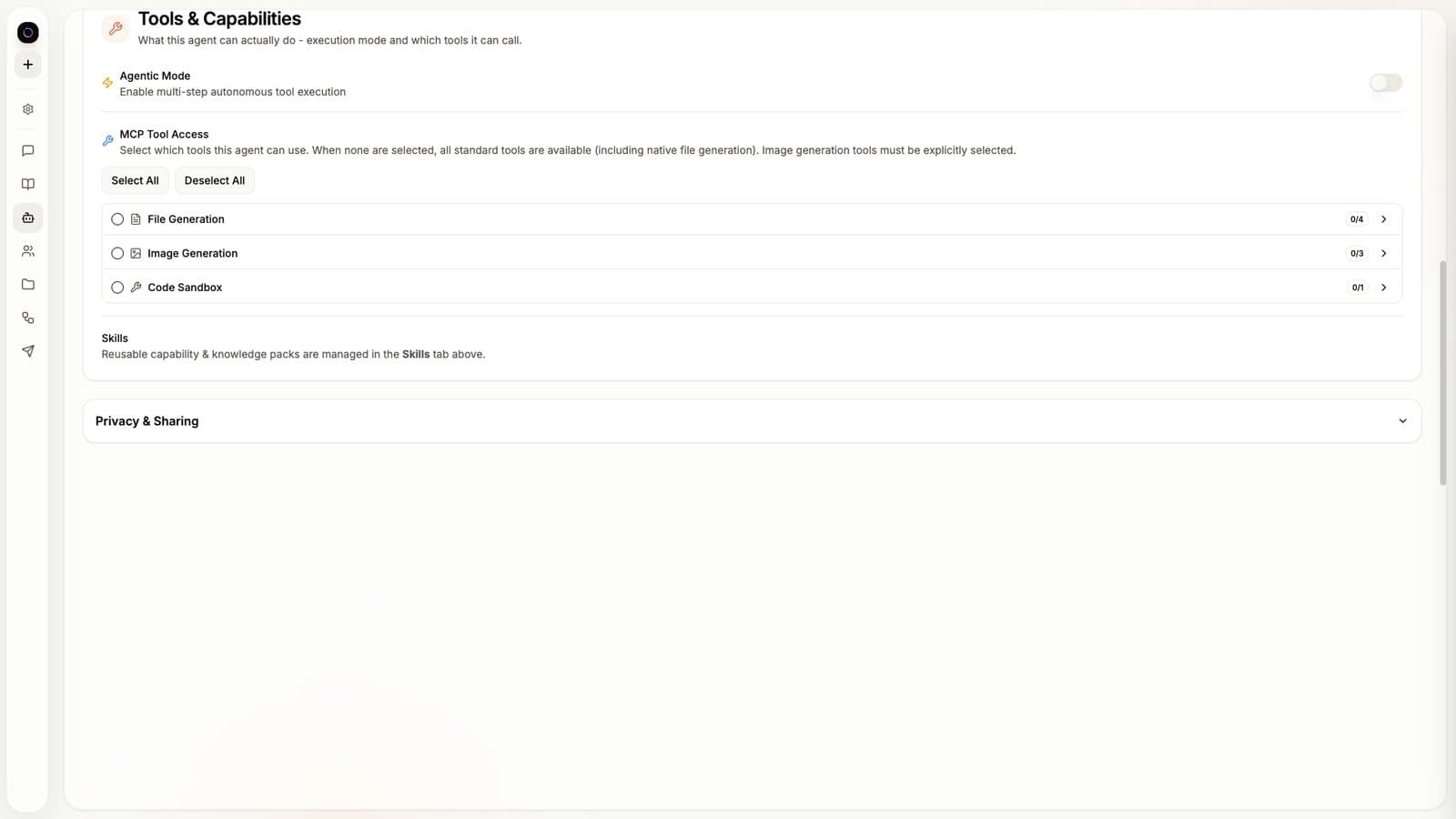
And exactly what it is allowed to touch
Abilities are granted one at a time. An agent that answers questions about opening hours has no business writing into a customer database, and the way to guarantee that is simply not to give it the ability. Most AI failures in companies are not bad answers. They are an assistant reaching something it should never have reached.
- Tool-level permissions
- Agentic mode toggle
- 06
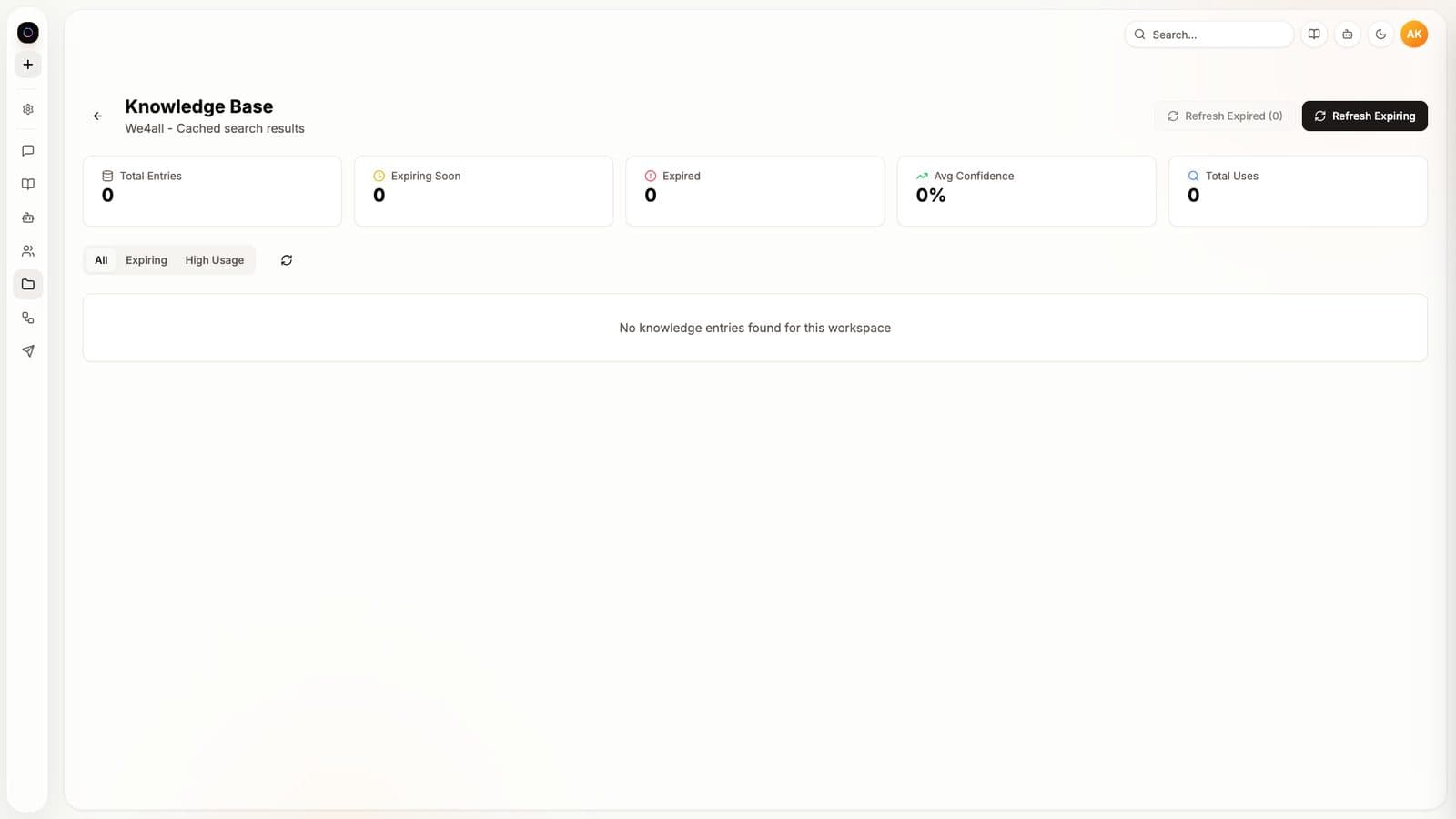
It answers from the company's own material
Menus, price lists, policies, the things a company already has written down go into the workspace, and the agents read from them. This is the difference between an assistant that sounds confident and one that is right. It is quoting the company, not the internet.
- Vector search
- Retrieval-augmented generation
- 07
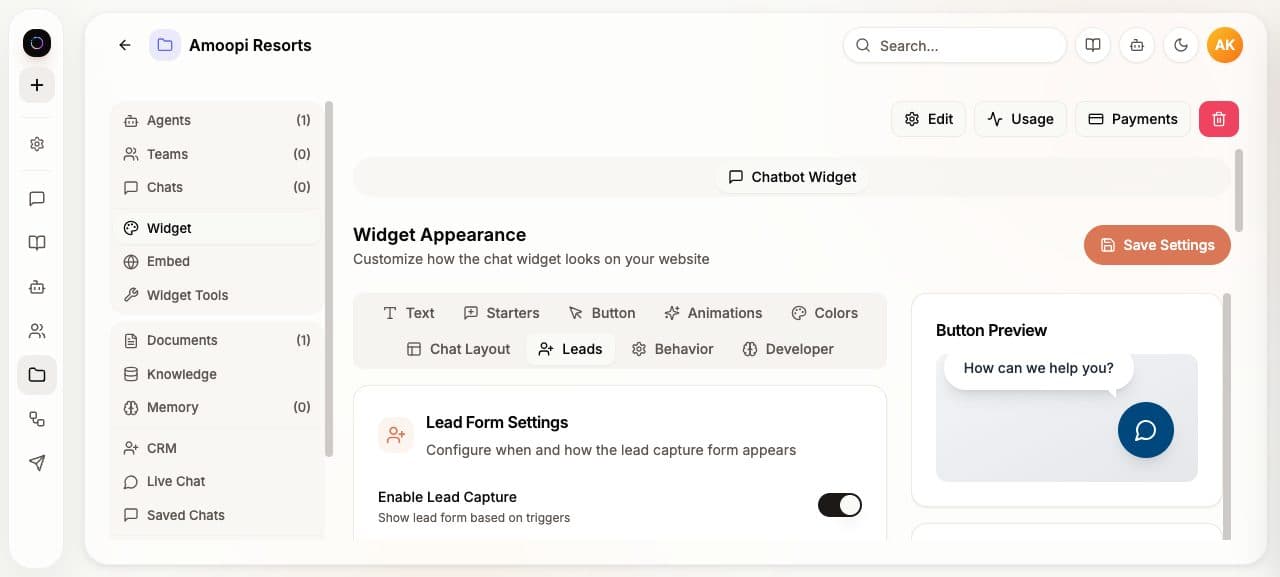
You decide when it asks for a name
A conversation that is going somewhere should end with a contact. The client chooses at what point the agent asks, and what it asks for. Some want it early, some only once a guest is clearly interested.
- Configurable capture rules
- 08
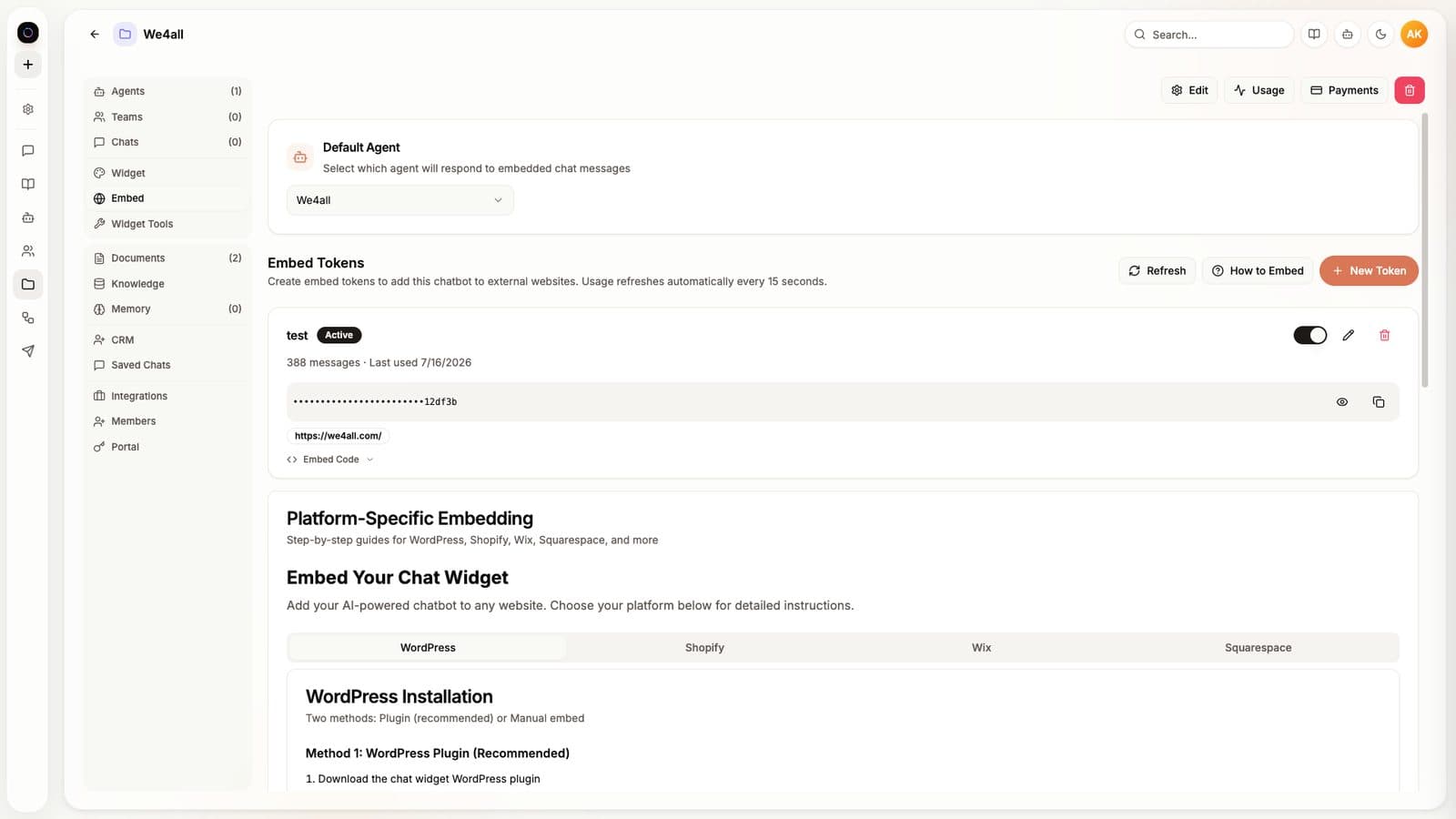
Then one line of code puts it on their site
No portal, no app, no new habit for anyone to learn. The agent appears on the website the company already has, styled to look like it belongs there.
- Embeddable widget
- Single script tag
- 09
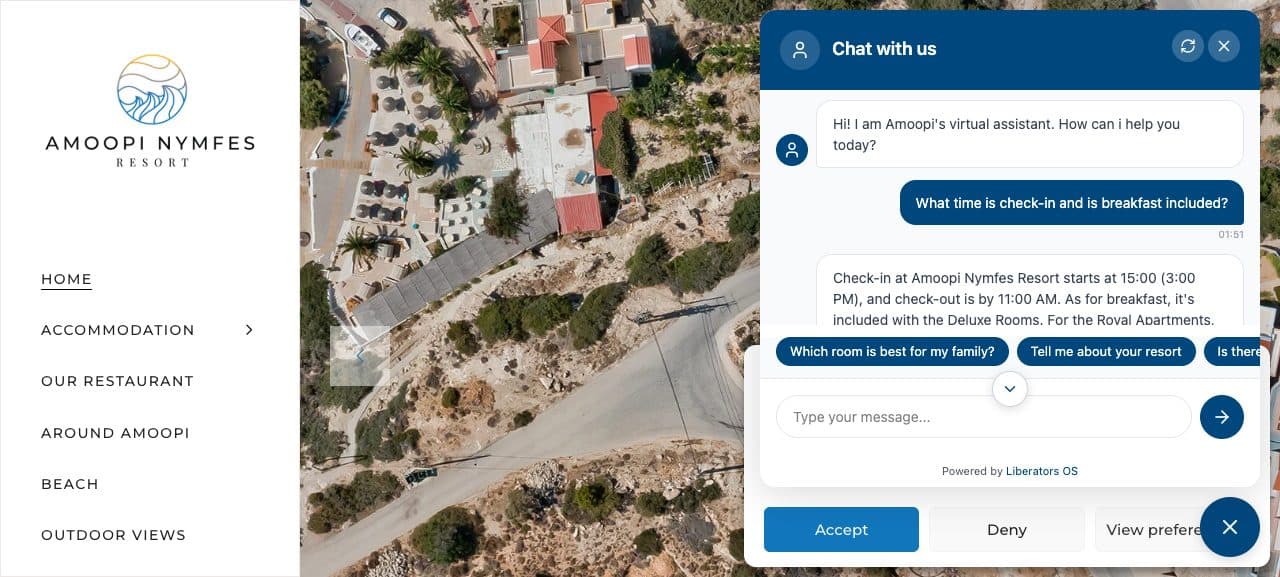
And it starts answering, at three in the morning
Here it is on a hotel's own site, answering a real question from a real visitor. Same agent, same material, no separate build for the website. It does not sleep, and it does not get less patient at the fortieth identical question.
- Streaming responses
- Context carried across turns
- 10
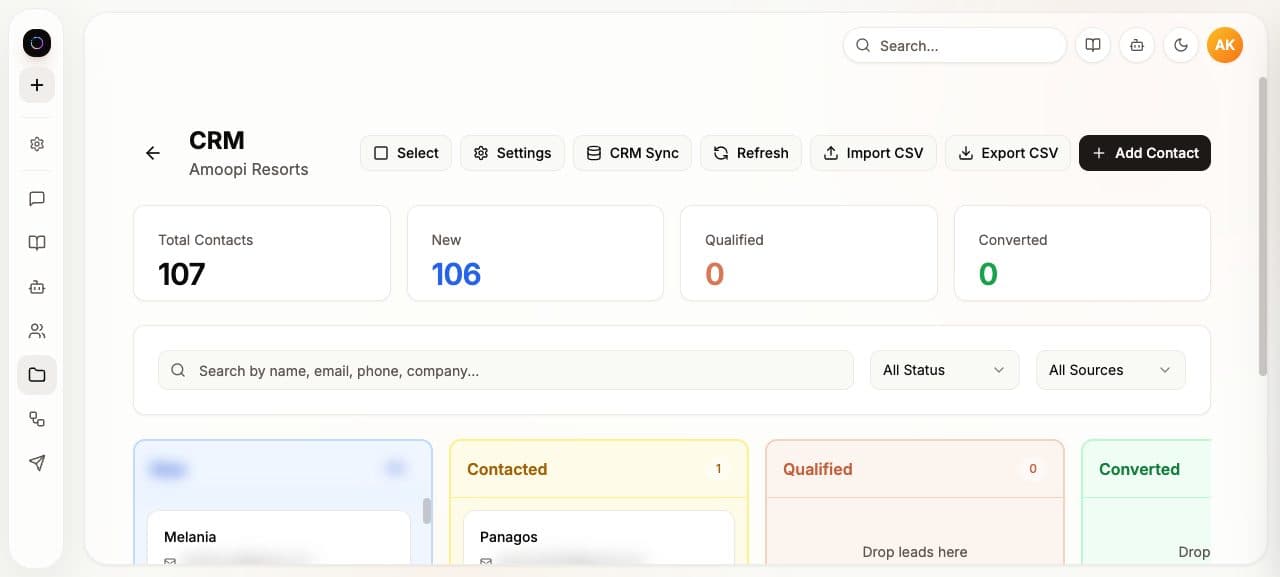
Everything it collects lands somewhere real
107 contacts from that one widget, sitting in a CRM inside the same workspace, exportable, assignable, with the conversation attached. The people who own the relationship see them without asking anyone for a report.
- Built-in CRM
- CSV export
- CRM sync
What it changed for the business
A hotel that could answer enquiries during office hours now answers them at any hour, in the visitor's language, and keeps the ones worth following up. The same system serves nine other companies without a line of new code.
- 107contacts captured by a single agent on one client's siteMeasured, in that client's CRM.
- ~11 hoursof enquiry handling those contacts representEstimate: 107 enquiries at roughly six minutes each to read, answer and record by hand.
- 10 clientsserved from one system, each isolated from the othersA new client is configuration, not a new build, so the tenth cost a fraction of the first.
- 24/7the hours it covers, in Greek and EnglishThe window that used to close at 5pm.
Built with
- Agent builder
- Knowledge base
- Embeddable widget
- CRM